

Top RPG Games with Immersive Storylines
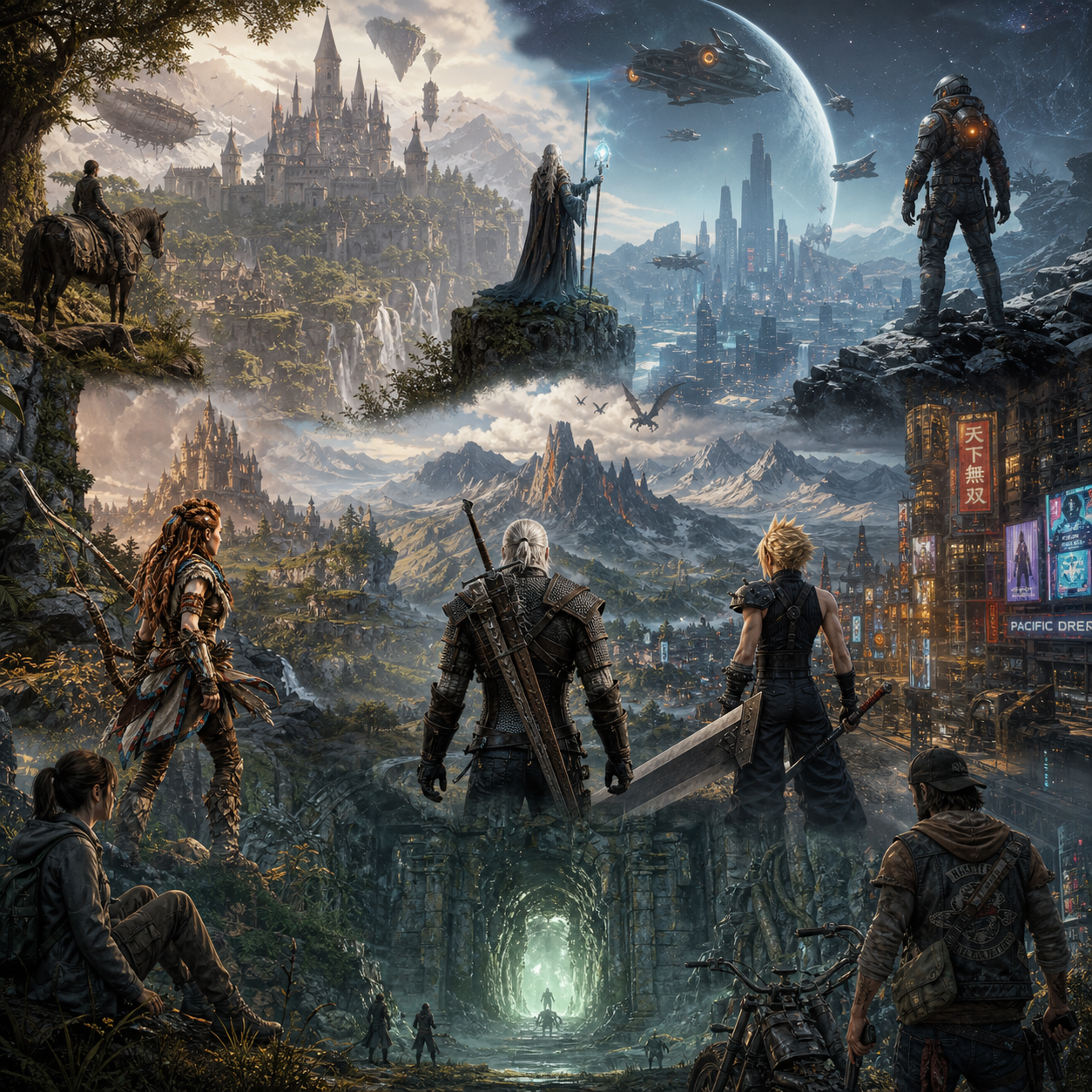
The best role-playing games make you care about more than winning a battle. Their characters feel layered, their quests carry emotional weight, and every location suggests a history beyond the current mission. For players seeking narrative-driven gameplay, the right RPG can feel like an interactive novel with exploration, combat, and personal decisions woven together.
This guide compares top RPG games with immersive storylines by examining world-building, character development, player choice, dialogue, quest design, exploration, and gameplay balance. Some are expansive open-world adventures, while others deliver tighter single-player campaigns with carefully controlled pacing.
What Makes an RPG Story Truly Immersive?
An immersive RPG storyline combines memorable characters, a convincing world, meaningful choices, and quests that create emotional stakes. Strong storytelling makes gameplay actions feel connected to the lives, cultures, and conflicts inside the game.
Character development is usually the first test. A compelling companion should have goals, weaknesses, relationships, and opinions that change as the campaign progresses. Dialogue matters because it gives players a reason to listen rather than skip every conversation.
World-building adds the larger framework. The setting should communicate its history through architecture, factions, books, environmental details, local customs, and optional conversations. A fantasy kingdom feels more believable when villages have different economies and political tensions. A science-fiction setting gains depth when technology affects ordinary citizens, not only the main plot.
Player choice creates personal ownership. Choices do not always need to produce completely different endings. A changed relationship, unavailable quest, altered faction response, or difficult sacrifice can make a campaign feel responsive.
- Memorable characters: Party members and rivals should have distinct voices and motivations.
- Meaningful quests: Missions should reveal the world or test the player’s values.
- Emotional stakes: The outcome should matter to people, communities, or relationships.
- Consistent rules: The world needs believable political, magical, technological, or social systems.
The strongest RPGs connect these elements. A quest can introduce a culture, deepen a companion’s personal arc, and force a decision that changes later dialogue. That kind of overlap creates immersion more effectively than visual detail alone.
Best RPGs for Rich World-Building
The Elder Scrolls V: Skyrim, Elden Ring, and Disco Elysium stand out for world-building, although they use very different storytelling methods. Skyrim offers open-world discovery, Elden Ring relies on environmental mystery, and Disco Elysium builds its setting through dialogue and political detail.
The Elder Scrolls V: Skyrim
Skyrim gives players a broad fantasy world filled with ancient ruins, competing factions, regional traditions, and optional quests. Its lore often appears through exploration rather than direct exposition. You may learn about a conflict from a book, a tomb, a conversation, or the layout of a forgotten settlement.
It suits players who want freedom and long-form exploration. The trade-off is uneven pacing: the main storyline can lose urgency when dozens of side activities compete for attention.
Elden Ring
Elden Ring uses a fragmented narrative built from landscapes, item descriptions, enemy placement, architecture, and selective dialogue. The game rarely explains every mystery immediately, which encourages community theories and careful observation.
This approach rewards players who enjoy reconstructing lore. It is less suitable for anyone who wants a clearly narrated plot with frequent explanations and highly directed quests.
Disco Elysium
Disco Elysium presents a politically complex city through investigation, internal dialogue, and role-playing choices. The protagonist’s skills act like competing voices, turning conversations into a psychological system rather than a simple path to information.
There is little conventional combat, so its appeal depends on reading, deduction, humor, and difficult social decisions. It is one of the strongest choices for players who value writing and setting over action.
For background on role-playing game design and the genre’s development, the Wikipedia overview of role-playing video games provides useful context.
RPGs with the Most Meaningful Player Choices
Baldur’s Gate 3, The Witcher 3: Wild Hunt, and Mass Effect Legendary Edition are excellent choices for branching narratives and consequential decisions. Each game lets choices influence relationships, quests, factions, or the campaign’s final direction.
Baldur’s Gate 3
Baldur’s Gate 3 offers unusually flexible problem-solving. Players can negotiate, investigate, sneak, fight, use spells creatively, or approach a quest from an unexpected angle. Party members react to decisions, and many outcomes depend on earlier conversations or seemingly minor discoveries.
Its depth comes with a learning curve. The turn-based combat system, dense rules, and large number of possible interactions may feel demanding during the first several hours. Players who enjoy tabletop-style role-playing and experimentation will find exceptional freedom.
The Witcher 3: Wild Hunt
The Witcher 3 is especially strong at presenting choices without obvious moral answers. Contracts and side quests often involve competing forms of harm, imperfect information, and consequences that appear much later.
The game balances a large open world with focused character writing. Its length can become a disadvantage for players seeking a compact campaign, particularly when exploration and side quests interrupt the central narrative.
Mass Effect Legendary Edition
The Mass Effect Legendary Edition combines a trilogy-wide science-fiction storyline with relationship systems and decisions that carry between games. Dialogue choices influence trust, alliances, and the emotional tone of the campaign.
It is ideal for players who enjoy a long-term character journey. Because the full effect of some choices emerges across multiple games, starting with the first entry provides the richest experience.
Best Character-Driven RPG Storylines
Persona 5 Royal, Final Fantasy VII Remake, and Dragon Age: Origins excel when party members and personal relationships drive the story. Their campaigns make character development central to progression rather than treating companions as simple combat tools.
Persona 5 Royal
Persona 5 Royal blends dungeon-crawling with school life, friendships, personal struggles, and social links. Time management shapes the experience: choosing one relationship or activity means postponing another, which gives ordinary days narrative importance.
The game is dialogue-heavy and stylistically distinctive. Its calendar structure also makes the early campaign lengthy, so it rewards players willing to settle into a measured rhythm.
Final Fantasy VII Remake
Final Fantasy VII Remake focuses on expressive party interactions, cinematic pacing, and the evolving relationships among Cloud, Tifa, Aerith, and Barret. The story is more linear than an open-world RPG, but that structure allows scenes and character beats to receive sustained attention.
Choose it if you prefer a guided adventure with action combat and strong presentation. Players seeking extensive branching storylines will find less freedom than in Baldur’s Gate 3.
Dragon Age: Origins
Dragon Age: Origins builds character investment through origin stories, party approval, faction conflicts, and personal quests. Companions frequently disagree with one another, creating a party that feels like a group of people rather than a collection of abilities.
Its older interface and combat design may require patience, but the role-playing foundations remain powerful. Decisions about identity, loyalty, and sacrifice are integrated into the campaign’s structure.

Story-Focused RPGs Across Different Settings and Styles
The best story-focused RPG depends on setting and format: choose Baldur’s Gate 3 or The Witcher 3 for fantasy, Mass Effect or Cyberpunk 2077 for science fiction, and Persona 5 Royal or Disco Elysium for modern settings.
- Fantasy and open-world exploration: Skyrim provides freedom, while The Witcher 3 offers denser quest writing and stronger authored storytelling.
- Dark fantasy: Elden Ring suits players who enjoy mystery, challenge, and environmental lore.
- Science fiction: Mass Effect emphasizes squad relationships and a broad galactic conflict; Cyberpunk 2077 focuses on identity, technology, and city life.
- Modern and social RPGs: Persona 5 Royal turns relationships and daily scheduling into core mechanics.
- Linear cinematic RPGs: Final Fantasy VII Remake delivers focused scenes, party chemistry, and action-oriented combat.
- Dialogue-driven experiences: Disco Elysium prioritizes investigation, ideology, and internal debate.
Setting is only half the decision. Consider how much control you want over pacing. Open-world games support discovery and optional quests, but they can dilute dramatic urgency. Linear games restrict exploration, yet they often deliver cleaner narrative momentum.
How to Choose the Right Story-Rich RPG
To choose the right story-rich RPG, match your preferred narrative style with campaign length, gameplay complexity, exploration, combat, and platform availability. Start with the experience you want to have, then select the game that supports it.
- Choose your story structure. Select branching narratives for meaningful decisions, a linear campaign for controlled pacing, or environmental storytelling for mystery and discovery.
- Set a time budget. A focused RPG may fit a few weeks of regular play, while open-world and trilogy-based campaigns can occupy many months.
- Decide how much reading you want. Disco Elysium and Persona 5 Royal demand sustained attention to dialogue; action-heavy games place more weight on movement and combat.
- Pick your preferred combat. Baldur’s Gate 3 uses turn-based tactics, Final Fantasy VII Remake uses real-time action, and some narrative RPGs make combat secondary.
- Check your platform. Availability varies across PC, PlayStation, Xbox, and Nintendo Switch, and performance can differ by version.
A useful filter is the story-to-freedom ratio. If you want every major scene to arrive at a deliberate pace, choose a more linear RPG. If discovering an unexpected village, faction, or quest matters more than plot momentum, choose an open-world adventure.
Avoid choosing solely by review score or genre label. Two fantasy RPGs can offer completely different experiences: one may focus on party dialogue and moral decisions, while another expects you to infer its lore from ruins and item descriptions.
RPG Storylines and the Wider Gaming Community
Story-focused RPGs connect with gaming communities through streaming, lore discussions, challenge runs, fan theories, and event-based play, even when they are primarily single-player campaigns. Their appeal is usually shared interpretation rather than direct competition.
Streamers can turn branching choices into audience discussions, while communities compare endings, companion outcomes, builds, and quest solutions without spoiling first-time players. Games such as Elden Ring and Baldur’s Gate 3 also generate strong theory-crafting communities because players can approach encounters and narratives in many ways.
These games can appear in tournaments, but organizers should choose formats carefully. A speedrun, no-death challenge, build-restriction contest, or blind-choice event is usually more suitable than a conventional head-to-head bracket. Narrative RPGs often lack equal starting conditions and standardized competitive balance.
For a games-and-tournaments website, the most engaging format may combine competition with storytelling: timed quest challenges, community voting on role-playing decisions, spoiler-safe lore quizzes, or tournament side events based on character builds. That respects the genre’s strengths while giving competitive gaming communities a structured way to participate.
Frequently Asked Questions
What is the most immersive RPG storyline?
There is no single answer because immersion depends on preference. The Witcher 3 is a strong choice for authored quests and open-world storytelling, Baldur’s Gate 3 for reactive choices, and Mass Effect for a long character-driven science-fiction campaign.
Which RPG has the best character development?
Persona 5 Royal, Dragon Age: Origins, Mass Effect Legendary Edition, and Baldur’s Gate 3 are excellent options. They give party members distinct motivations, evolving relationships, and personal arcs that affect the wider campaign.
Are open-world RPGs better for storytelling?
Open-world RPGs are better for exploration and optional discovery, but they are not automatically better storytellers. Their freedom can weaken pacing, while linear RPGs often deliver more focused character development and dramatic structure.
What RPG is best for players who enjoy meaningful choices?
Baldur’s Gate 3 is one of the strongest choices because decisions can affect quests, relationships, combat approaches, and later outcomes. The Witcher 3 and Mass Effect are also excellent for difficult moral and interpersonal decisions.
Can story-focused RPGs be played competitively or in gaming events?
Yes, although they usually work best in speedruns, challenge formats, build contests, lore quizzes, and community events rather than traditional multiplayer tournaments. Their appeal lies in varied solutions and narrative interpretation, not perfectly symmetrical competition.